Key takeaways
- Hydrogen is Shopify's React framework, built on React Router 7, with commerce components, caching and analytics built in.
- Hydrogen storefronts deploy to Oxygen, Shopify's hosting for headless storefronts.
- Next.js is a general-purpose React framework with a huge ecosystem, commonly hosted on Vercel.
- Choose Hydrogen for a Shopify-first store; choose Next.js when the site mixes commerce with a large content or application platform.
- Either way, the cost is in building and maintaining a custom frontend, not the framework.
Once you have decided to go headless, the next question is the framework. On Shopify the choice usually comes down to Hydrogen or Next.js. Both are React frameworks; both can build fast, beautiful storefronts.
What Hydrogen gives you
- Commerce built in: Components and utilities for carts, product options, money formatting, SEO and analytics.
- Storefront API integration: A typed, cached client for Shopify's Storefront API.
- Oxygen hosting: Shopify's global hosting for Hydrogen storefronts, deployed from your Git repository.
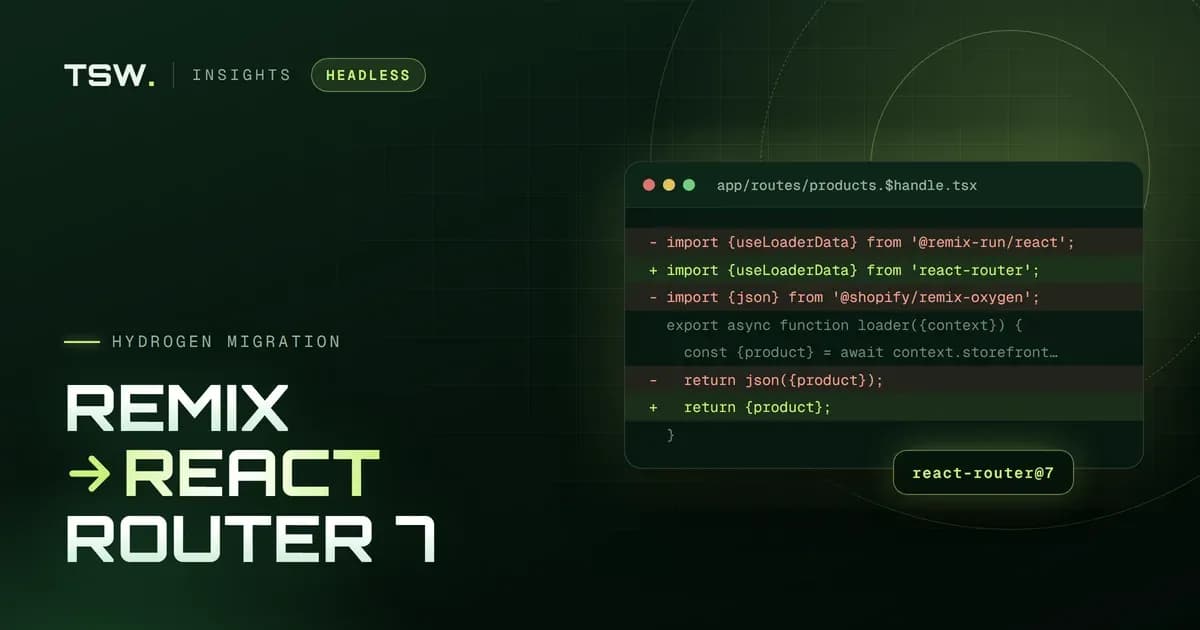
- React Router 7: Hydrogen now builds on React Router 7, with loaders, streaming and nested routes.
What Next.js gives you
- A huge ecosystem: The most widely used React framework, with countless libraries, integrations and developers.
- Flexible rendering: Static generation, server rendering and incremental regeneration per page.
- Content-first sites: A natural fit when commerce sits inside a larger content or application platform.
- Hosting choice: Commonly deployed on Vercel, but it can run on any Node.js host.
Side by side
- Time to first commerce features: Faster with Hydrogen — the commerce building blocks are ready.
- Shopify alignment: Hydrogen follows Shopify's roadmap closely; Next.js integrations are maintained by you or the community.
- Non-commerce features: Next.js has the broader ecosystem for dashboards, portals and complex content.
- Hiring: Next.js developers are easier to find; Hydrogen needs React developers who also know Shopify.
Our recommendation
For a store that is primarily a Shopify storefront, Hydrogen is usually the shorter, safer path. For a brand whose website is mostly content, community or software — with commerce as one part — Next.js is often the better foundation. In both cases, most of the cost is the custom frontend itself, so be sure headless is right before choosing a framework.
We build with both: headless Shopify with Hydrogen and Next.js development. If you already run Hydrogen, see what changed in the move to React Router 7. Talk to us about your project.
Filed under
 Jay Patel