Key takeaways
- Headless is a tool for specific problems, not an upgrade every store needs.
- A well-built Liquid theme can pass Core Web Vitals; speed alone is rarely a reason to go headless.
- Headless moves everyday changes from the theme editor to developers — budget for that.
- Many Shopify apps plug into themes and need custom work on a headless storefront.
- We recommend headless in roughly one project in four, and say so plainly when a store does not need it.
Few questions in ecommerce get answered by taste as often as this one. Headless sounds modern; Liquid sounds safe. Neither is a strategy. The right answer depends on what your store needs to do, who will run it and what it will cost over the next two years — and it can usually be settled in an afternoon.
Liquid vs headless, in one paragraph
A Liquid theme is Shopify's native storefront: pages are rendered by Shopify, edited in the theme editor and extended with sections and app blocks. A headless storefront separates the front end from Shopify's back end — typically built with Hydrogen on React Router 7 and hosted on Oxygen — and fetches products, carts and customers through the Storefront API. You gain total control over the experience, and you take on the engineering Shopify's theme layer used to do for you.
Four questions that settle it
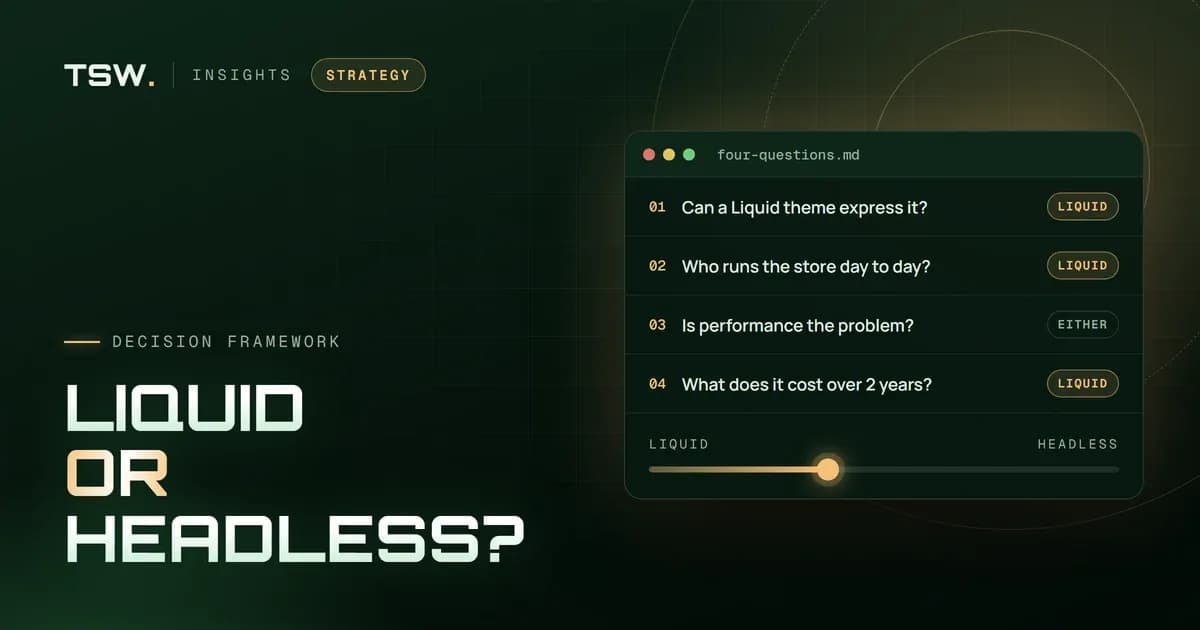
1. Can a Liquid theme express the experience you need?
Online Store 2.0 themes, sections everywhere, theme app extensions and Checkout Extensibility cover far more than they did a few years ago. If the goal is a fast, beautiful, conversion-focused store, Liquid can deliver it. Headless earns its place when the experience itself is the product: app-like interactions, rich configurators, or content that lives in another system.
2. Who will run the store day to day?
With a Liquid theme, your team rearranges pages, launches campaigns and edits content without a developer. On a headless storefront many of those changes need code, unless you add and maintain a CMS. Without developers — in-house or on a retainer — headless turns small changes into tickets.
3. Is performance really the problem?
Headless is not automatically faster. A lean, well-built Liquid theme can pass Core Web Vitals comfortably; a heavy headless build can fail them. If speed is the issue, fix the theme, the app bloat and the images first — it costs a fraction of a rebuild.
4. What does it cost over two years?
Compare the whole bill, not the build quote: development, ongoing engineering, any CMS, re-integrating apps that relied on the theme, and the cost of slower changes. Headless usually costs more to build and more to run, so it has to earn that back.
Three situations where headless costs more than it returns
- Catalogue stores that need speed and conversion: The wins come from a better theme, cleaner apps and CRO — not a new architecture.
- Teams without developers: Every change becomes a development task, and momentum drops.
- Stores built around theme apps: Reviews, bundles, subscriptions and loyalty widgets often plug into the theme; on headless each needs a custom integration.
When headless is clearly the right call
- Several brands or regions served from one codebase, each with its own storefront.
- Content-led experiences driven by a separate CMS, where content and commerce must blend.
- App-like features — configurators, 3D, heavy personalisation — that fight the theme layer.
- Commerce inside an existing React application that already has its own front end.
The middle path most stores miss
It is rarely all-or-nothing. A Liquid theme with custom sections, theme app extensions, Shopify Functions and checkout UI extensions covers most bespoke requirements. Where one part of the experience genuinely needs more — a configurator, a campaign microsite — it can be built separately and linked into the store, without rebuilding everything around it.
How we make the call
Every project starts with a one-week Discover stage: we audit the store, map requirements and costs, and put a written recommendation in front of you — including when the answer is that you do not need headless. We recommend it in roughly one project in four.
Whichever way it goes, we build both: Shopify Plus and Liquid themes and headless Hydrogen storefronts. Tell us about your store and we will give you a straight answer.
 Jay Patel