Key takeaways
- Shopify is a hosted platform: hosting, security and updates are handled for you, for a monthly fee.
- WooCommerce is free software on WordPress: you pay for hosting, extensions and the time to maintain them.
- Both can rank well in search; speed and content matter more than the platform.
- Shopify suits brands that want to focus on selling; WooCommerce suits teams that want full control of the code or run content-led sites.
- Compare the total cost over two to three years, not the monthly price.
Shopify vs WooCommerce is one of the questions we're asked most. We develop on both platforms, so we have no reason to push either — and the honest answer is that each is the better choice for a different kind of business.
Shopify vs WooCommerce at a glance
- What it is: Shopify is a hosted ecommerce platform. WooCommerce is a free, open-source plugin that turns a WordPress site into a store.
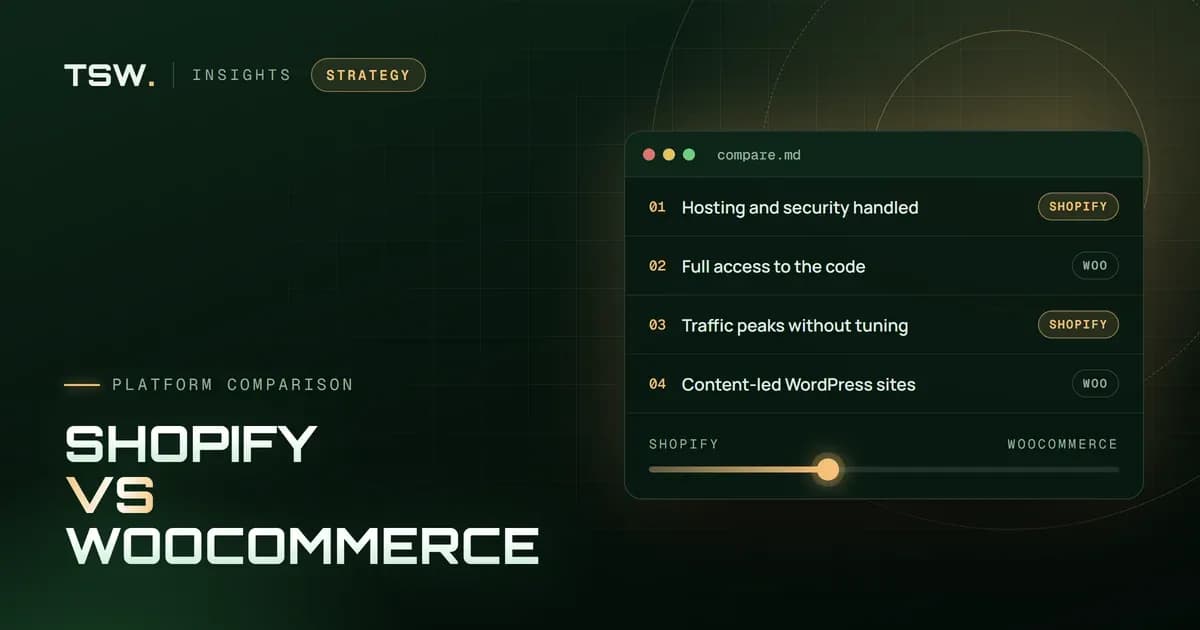
- Hosting and security: Shopify includes hosting, SSL, a global CDN and PCI DSS compliance. With WooCommerce, you choose and manage hosting, security and backups.
- Cost: Shopify plans cost $39 to $399 a month billed monthly, with Shopify Plus from $2,300. WooCommerce is free; hosting, premium extensions and maintenance are not.
- Ease of use: Shopify's admin is built for merchants and needs little technical knowledge. WooCommerce is flexible but needs someone to manage updates and plugin compatibility.
- Customisation: WooCommerce gives full access to the code and database. Shopify is customised through themes, apps, metafields and Shopify Functions, within the platform's rules.
- Scalability: Shopify scales automatically for traffic peaks such as Black Friday. WooCommerce scales well with the right hosting and engineering.
Cost: Shopify vs WooCommerce pricing
On paper WooCommerce is free and Shopify is not. In practice, both have a total cost of ownership:
- Shopify: The plan fee, card processing (or a surcharge of 2%, 1% or 0.6% on Basic, Grow and Advanced if you use another payment provider), paid apps and a theme.
- WooCommerce: Hosting that copes with your traffic, a premium theme, paid extensions for features Shopify includes, payment processing and developer time for updates, security and fixes.
For a small store, WooCommerce can be cheaper. As traffic and the catalogue grow, managed hosting and maintenance often close the gap. Compare costs over two to three years, including your team's time. Our guide to how much a Shopify website costs breaks down the Shopify side.
Ease of use and maintenance
Shopify handles platform updates, security patches and uptime. WooCommerce stores need regular WordPress, theme and plugin updates, and any update can cause a conflict, so a staging site and backups are essential. Without a developer on hand, that maintenance is the biggest hidden cost of WooCommerce.
SEO: is Shopify or WooCommerce better?
Both can rank well. WordPress gives WooCommerce fine control over URLs and content, and it remains excellent for content-led sites. Shopify uses fixed URL prefixes such as /products/ and /collections/, which rarely affects rankings, and handles sitemaps, canonical tags and fast hosting for you. On either platform, speed, content and a clean technical setup matter far more — see our Shopify SEO checklist.
Features and flexibility
- Checkout: Shopify's checkout is fast and trusted, with Shop Pay built in; deep customisation needs Shopify Plus. WooCommerce's checkout can be changed freely, which is powerful but easy to slow down.
- Apps and extensions: Both have large marketplaces. Shopify apps are hosted and reviewed by Shopify; WooCommerce extensions run on your server, so quality and performance vary more.
- Headless: Shopify offers Hydrogen and Oxygen for headless storefronts; WooCommerce can run headless through its Store API and WordPress's APIs.
- Selling everywhere: Shopify connects natively to marketplaces, social channels and its own point-of-sale system.
When to choose Shopify
- You want to focus on products and marketing, not servers and updates.
- You expect traffic peaks from campaigns and sales events.
- You sell across online, social and in-store channels.
- You plan to grow into Shopify Plus features such as advanced B2B or expansion stores.
When to choose WooCommerce
- Content is at the heart of your site and you already run WordPress.
- You need unusual custom logic, or full ownership of the code and data.
- You have a developer or agency to maintain it.
- Your catalogue and traffic are modest, so hosting costs stay low.
Switching from WooCommerce to Shopify
If you have outgrown WooCommerce, moving is well-trodden ground, as long as redirects and data mapping are planned properly. Our WooCommerce to Shopify migration guide walks through the process step by step.
Not sure which is right for you? We build Shopify stores and WooCommerce sites, so we can recommend the platform that fits your plans. Ask us.
Filed under
 Jay Patel